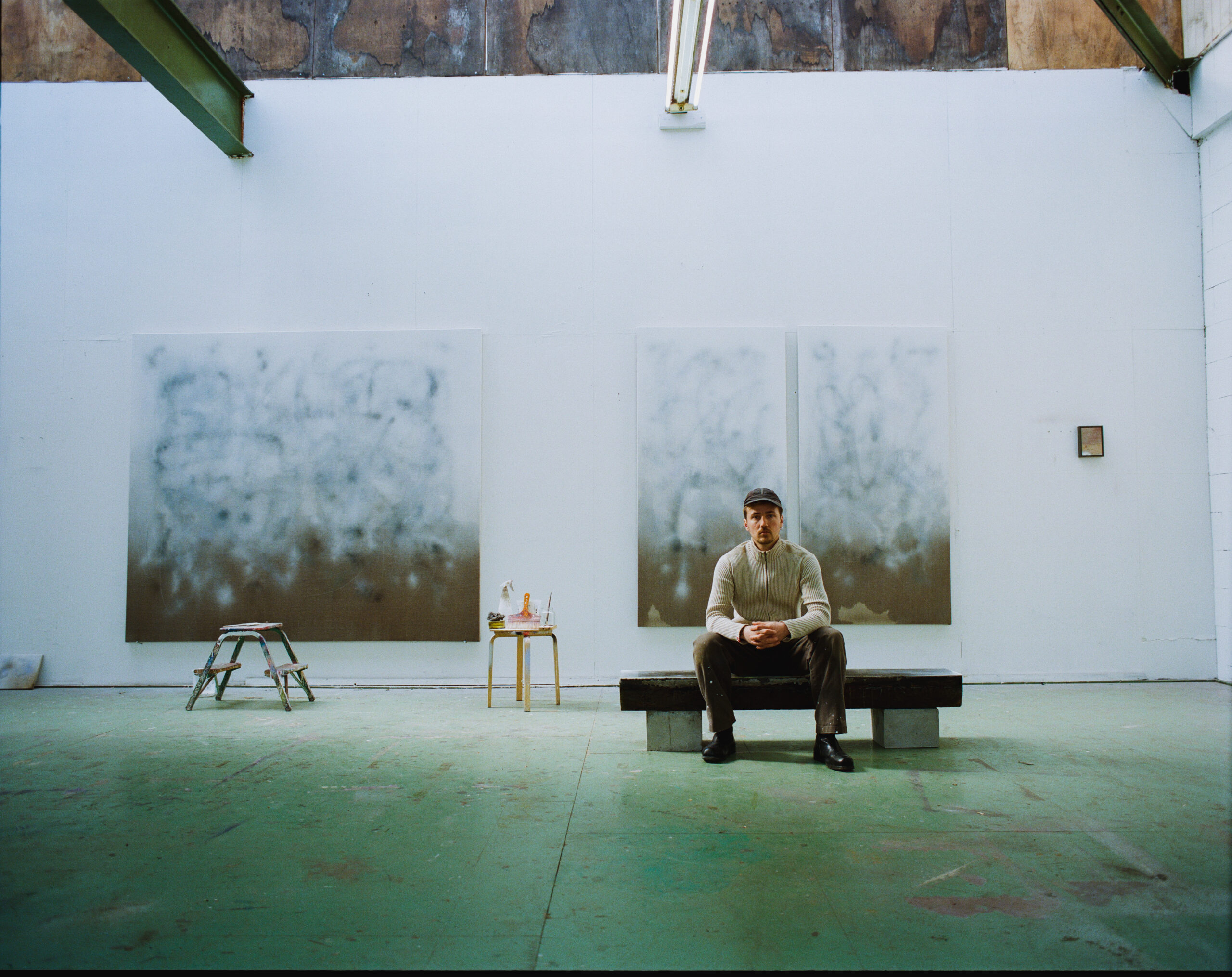
Kaspar in his atelier captured by Stefan de Vilder, Amsterdam, March 2026
Kaspar Dejong is a multi-disciplinary artist from Maastricht who resides in Amsterdam. His works have been garnering a lot of attention as of late and are shown internationally in countries such as Belgium, Japan, France and more. In his work, he draws inspiration from ever-changing urban landscapes which he translates into paintings, sculptures and installation work.
Kaspar has been a long-time friend of the brand and has made works to accompany our presentations and showrooms. In his atelier in Amsterdam, we caught up with him and viewed his latest works.
Question S&C: You just came back from an exhibition in Paris, and will soon be in Brussels for another–the future seems bright for 2026. Are there any projects in particular you are excited about, perhaps beyond exhibitions?
Answer KD: For the past year, I’ve been working on an artist publication in collaboration with Jules Janssen: a book showcasing 10 years of archival photography. Most people know my work through paintings and installations, but photography always plays a fundamental role. The starting point of my practice and work often occurs by coincidence–in public spaces where certain happenings pique my interest. These subjects, that I quickly document with my phone or on film, are often the starting points for further inspirations that take shape in painting or installation. The book showcases these spur of the moment documentations and functions as one big retrospective; not so much focusing on my own practice but rather on the inspirations that constitute the base of my work.
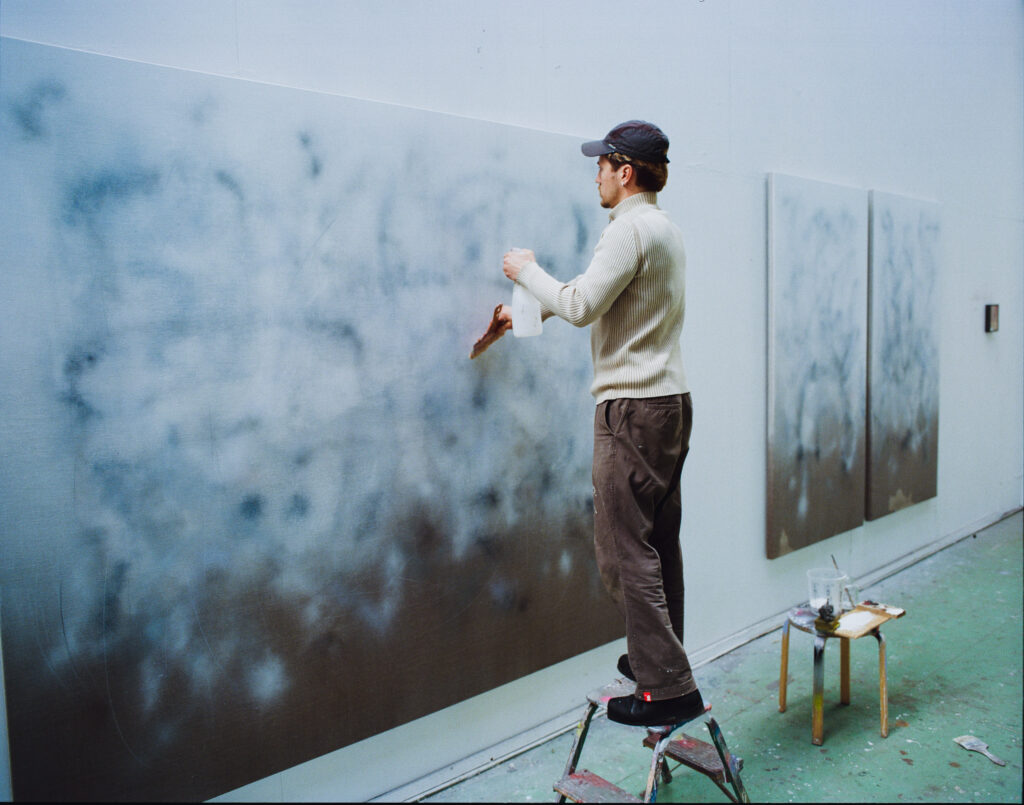
Question S&C: Much of your work is inspired by urban landscapes and the traces of human activity that are left within them–perceiving objects objectively, without a pre-conceived notion. This has led to research into the changing historical experiences of surroundings and the concept of palimpsests. How has your background in graffiti-art and tagging as a youngster shaped this research and the resulting work that comes from it?
Answer KD: It has always been the base for how my ideas were shaped–wandering through different public areas, reading the landscape and translating that into new ideas. It’s a practice that constantly questions the function of that landscape and how to unlock or add new layers to it. I think that the layering, the multi-purposed space, its users and all other facets make it such a rich environment to draw inspiration from. Coincidence brings together planned, disruptive and rigid forms that collide in a single space–that’s what makes it dynamic. I think concept of dynamism, and the layering that comes with it, is also very visible in my methodology and work. Covered up expressions, comprehension of mistakes, a very much visual rhythm.
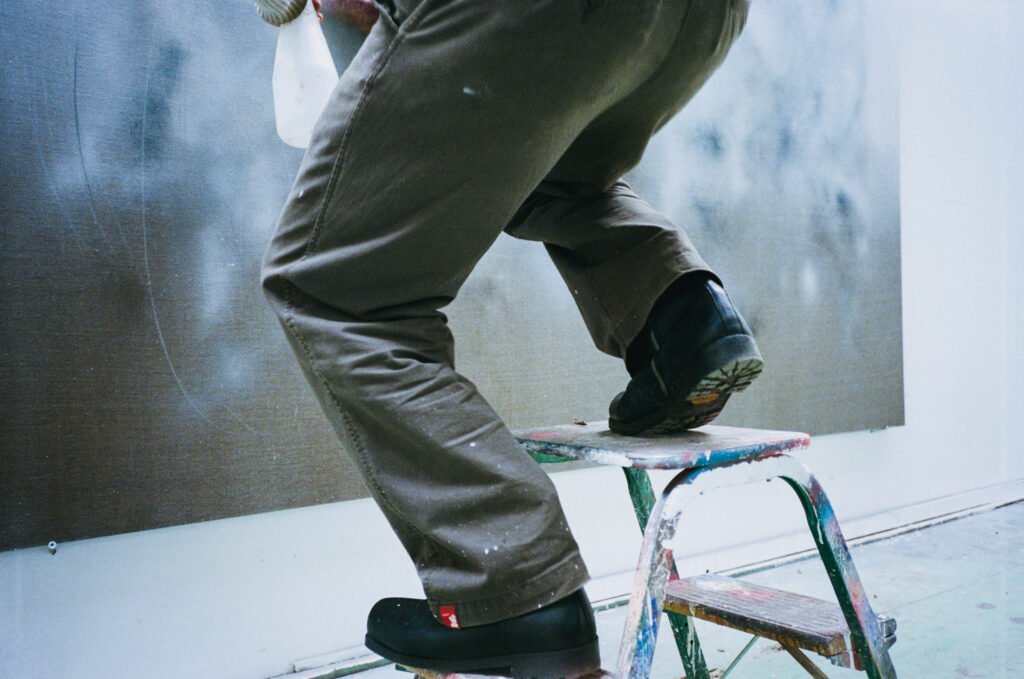
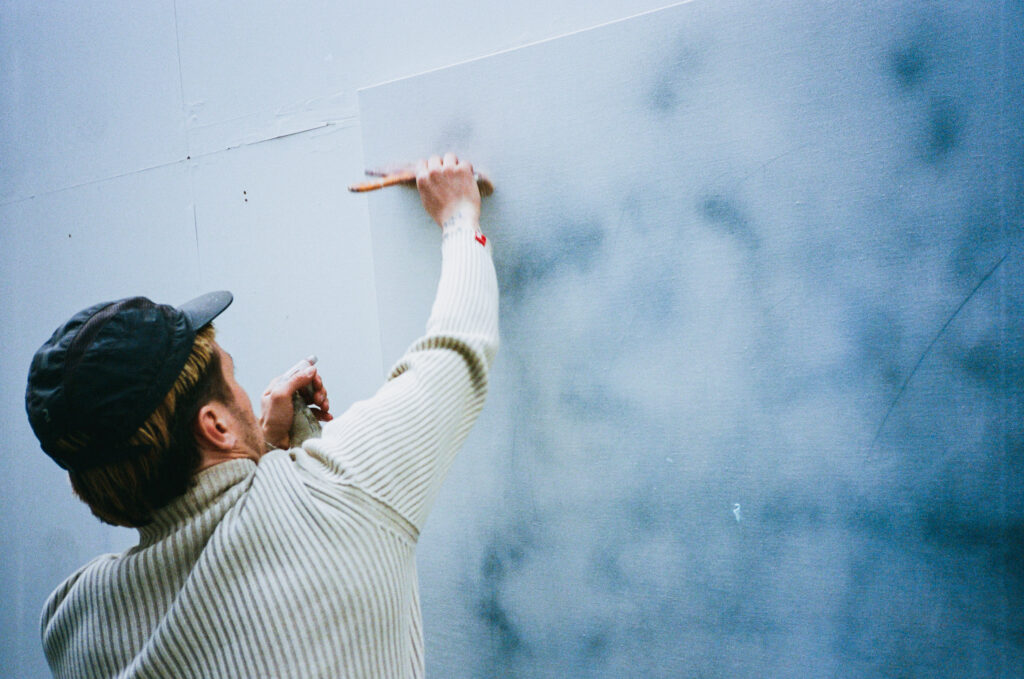
Question S&C: In your art, you often repurpose or recreate materials found in urban landscapes. For example, you’ve made work inspired by the color of Japanese cherry blossoms and repurposed mooring posts of the Amsterdam canals into furniture. In all your travels, was there a place that you’ve visited that had an especially inspiring cityscape?
Answer KD: What I enjoy about repurposing materials is that it carries a history within. It invites you to read and interpret it, which will guide the process in a certain direction. There is a constant dialogue between the object and yourself–your response becoming the work. Whilst working on sight, I make a direct connection with the source of the materials that I’m using. It becomes very personal, but at the same time very detached or dislocated. The story that enfolds must be narrated with care.
One specific investigation that comes to mind was an abandoned industrial site in Lisbon that I visited in 2024 during a residency. There used to be a former steel forgery that left a lot of metallic waste material in the surrounding area–that area being the size of a small village. Across that area, the earth had been contaminated with metal and iron particles that started oxidizing, turning it into these surreal purple, red and brown plains. I harvested the pigments on site and made a series of small oil paintings that drew further upon the idea of the landscape.
Question S&C: Would you say that in any of your endeavors, there is a philosophy that you adhere to? Are there any rituals you do, or habits you have, to get into the right mindset? Or, is every project treated with an entirely different approach?
Answer KD: Whenever I start a new series of work, especially with paintings, everything has to be aligned in my mind. There’s always this moment before I start where I can clearly visualize the final result for just a split second, a certain gut feeling. When that moment has passed, everything gets messy. I keep searching for that image, and I have to solve problems until, suddenly, a moment appears where I can once again clearly visualize it. Things will start falling into place again–then I know I’m almost there.
However, when it comes to sculptural and/or installation work, it asks for a much more technical and labour-intensive approach. When I work with industrial materials like concrete, steel or wood, I often make a plan beforehand. I sketch out the construction, and do small tests to see if things work out the way they should.
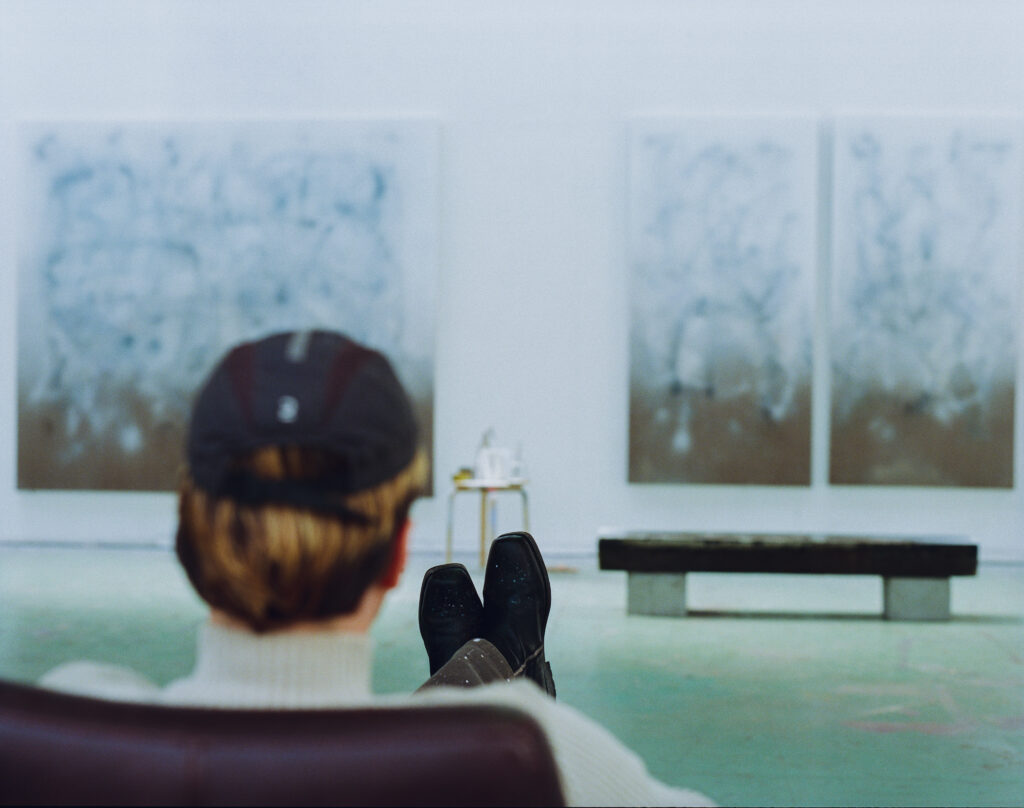
Kaspar in his atelier captured by Stefan de Vilder, Amsterdam, March 2026
Question S&C: When you first came across Sine & Cosine, what was it that stood out to you? Has your relation to the products evolved over time, and if so, in what way?
Answer KD: When I first got in touch with the brand, I appreciated its niche approach. Nowadays, there are a lot of brands that focus on the whole spectrum of ready-to-wear. You don’t often encounter young makers that have the focus to engage deeply in one field, and specialize in that specific craft–in the case of S&C; shoes. Over time, I have seen the brand develop and deepen its artistic vision, daring to take risks and develop its signature. Besides their own passion for the craft of shoe making, you can also sense a deeper understanding of visual arts in how they approach showrooms and presentations. I think that’s something outstanding to see in a young fashion brand these days.